 Ecological technician, April Bradshaw, photographed this Tarantula Hawk in a wash along the North Road (towards Longstreet) on June 30. The 2.5 inch wasp was crawling all over a Desert Milkweed plant, eating its nectar and pollen. If you don't know anything about Tarantula Hawks, they are a huge wasp nearly 3 inches in... length that are spider hunters. They feed primarily on tarantulas and trap-door spiders, luring them out of their burrows by probing the spider's silk entrances. The wasp then stings the spider, injecting paralizing venom. Next the wasp drags the victim into a burrow, lays a single egg on it, then seals the entrance. The larva will hatch and feed on the still-live prey and emerge next spring.

Showing posts with label Ash Meadows. Show all posts
Showing posts with label Ash Meadows. Show all posts
Friday, July 9, 2010
Tarantula Hawk wasp at Ash Meadows
Ecological technician, April Bradshaw, photographed this Tarantula Hawk in a wash along the North Road (towards Longstreet) on June 30. The 2.5 inch wasp was crawling all over a Desert Milkweed plant, eating its nectar and pollen. If you don't know anything about Tarantula Hawks, they are a huge wasp nearly 3 inches in... length that are spider hunters. They feed primarily on tarantulas and trap-door spiders, luring them out of their burrows by probing the spider's silk entrances. The wasp then stings the spider, injecting paralizing venom. Next the wasp drags the victim into a burrow, lays a single egg on it, then seals the entrance. The larva will hatch and feed on the still-live prey and emerge next spring.

Friday, June 18, 2010
Ash Meadows NWR
 Some animals just don't mind the heat... Spiny Lizard parading his mating colors
Photo by Cyndi Souza
Tuesday, June 15, 2010
Ash Meadows NWR
 Here's a gopher snake taking a swim...
 ... under the watchful gazes of a Pahrump 4H club and Refuge employee, Alyson Mack.
 Recently sited at Devil's Hole was this Chuckwalla lizard.
Monday, June 7, 2010

Thursday, May 27, 2010
Recent Sitings by Carl Lundblad
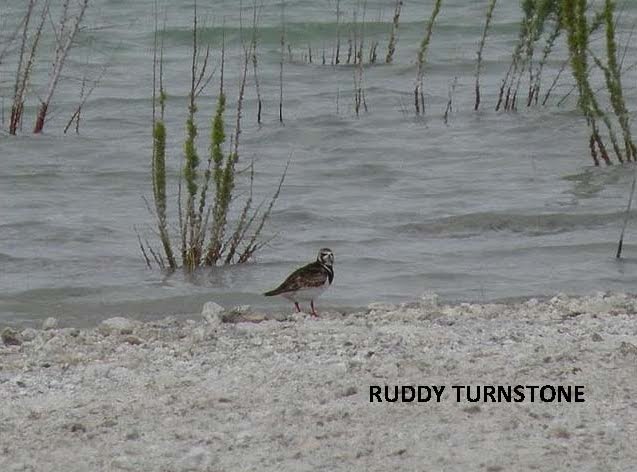

Carl's notes from May 23, 2010 ----->
I birded Ash Meadows NWR this morning where the highlights were a RUDDY TURNSTONE and a female PURPLE MARTIN, both at Crystal Reservoir. Other shorebirds at Crystal Reservoir included 2 SANDERLINGS, one of which was in alternate plumage, and about 46 Spotted Sandpipers. There were several hundred other swallows present comprised of about 50% Cliff, 40% Violet-green, 7% Barn, and 3% Bank.
The Ash Grove below the reservoir had a few migrants including an OLIVE-SIDED FLYCATCHER. This seems to be the best place on the refuge to find BROWN-CRESTED FLYCATCHERS this year. Driving around the Crystal Reservoir Loop road produced 2 additional OLIVE-SIDED FLYCATHERS, many Wood-pewees, and some common warrblers.
Point of Rocks and Bradford Spring were both good for common migrants and breeders including:
*POINT OF ROCKS 7:00-8:30*
W. Wood-pewee 6
"Western" Flycatcher 5
Dusky Flycatcher 3
Hammond's Flycatcher 1
Cassin's Vireo 1
Black-tailed Gnatcatcher 2
Warbling Vireo 3
Lucy's Warbler 6
Yellow Warbler 10
Wilson's Warbler 22
MacGillivray's Warbler 1
Common Yellowthroat 4
Yellow-breasted Chat 5
Blue Grosbeak 5
Lazuli Bunting 1
Bullock's Oriole 2
SUMMER TANAGER 2
Western Tanager 2
*BRADFORD SPRING 8:35-9:20*
Virginia Rail-seen flying through the mesquite, about 8 feet off the
ground, towards the spring pool!
White-throated Swift 1
W. Wood-pewee 3
"Western" Flycatcher 2
"Solitary" Vireo 1
Warbling Vireo 1
Blue-gray Gnatcatcher 3
Lucy's Warbler 2
Yellow Warbler 6
Wilson's Warbler 12
MacGillivray's Warbler 1
Common Yellowthroat 1
Western Tanager 1
SUMMER TANAGER 1
Blue Grosbeak 5
Black-headed Grosbeak 1
Carl Lundblad
Ash Meadows, NV
A few May friends at Ash Meadows NWR
 Mariposa Lily
Photo courtesy of Erin Bradshaw.
 Green Dragonfly
 Red Dragonfly
  Red Racer Snake
 Side Blotched Lizard
  Spiny Lizard
 Western Pygmy Blue Butterfly
Photos courtesy of Cyndi Souza.


Ash Meadows Carson Slogh Restoration Project

During December 2009, Ash Meadows National Wildlife Refuge (Refuge) began Phase 1 of the Upper Carson Slough (UCS) restoration project. Prior to Refuge establishment in 1984, Ash Meadows underwent dramatic landscape alteration as spring outflows were diverted for agriculture and ranching. Approximately two miles of the upper Fairbanks outflow was reconstructed along its historic drainage during Phase 1 of the UCS project. Historically, Fairbanks Spring and outflow were occupied by three native fishes: the endangered Ash Meadows Amargosa pupfish (Cyprinodon nevadensis mionectes; pupfish), endangered Ash Meadows speckled dace (Rhinicthys osculus nevadensis; dace), and Ash Meadows killifish (Empetrichthys merriami). Currently, pupfish are the only native fish present in the system. Ash Meadows killifish have been extinct on the Refuge since the 1950’s and dace have not occurred in the Fairbanks system since the 1970’s.

Additionally, two native snails occur in Fairbanks Spring and its outflow. The Fairbanks springsnail (Pyrgulopsis fairbankensis; snail) only occurs in the Fairbanks system. The Sportinggoods tryonia snail (Tryonia angulata; snail) only occurs in two other spring systems within the Refuge.
In March 2010 three volunteer events (24th, 27th, and 28th) took place along Fairbanks outflow. The purpose of these volunteer events was to salvage pupfish and snails from the old Fairbanks channel (and move them into the new outflow), which was to be abandoned, and to offer the public an opportunity to interact with the fish and snails while assisting with an important restoration project in the Refuge. Volunteers contributed 297 volunteer hours over the three days. In total, 3,150 pupfish and 12,000 endemic snails were salvaged. Additionally, 2,710 non-native red swamp crayfish (Procambarus clarkii; crayfish) were removed.

Text excerpted from a memo by Darrick Weissenfluh. Photos by Harry Konwin
Subscribe to:
Posts (Atom)